|
|
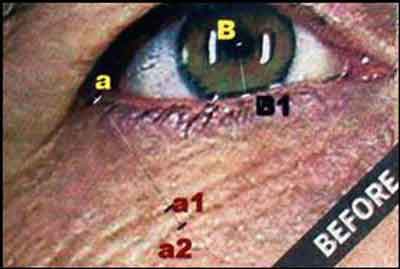
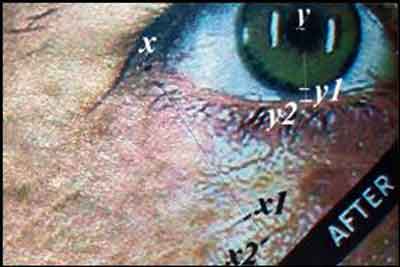
| As that great sage Jennifer Aniston used to say, here’s the science bit. We need to do some measurements. The shadows can reveal the depth of the wrinkles, but in a photograph it’s unrealistic to gain any accurate indication of how much shallow they might be. Otherwise, we do have a good pair of pictures to compare. Superimposing the images confirms that they are identical in terms of direction of gaze and angle of imaging. So let’s obtain two important categories of data: first, the spatial separation of the wrinkles (a) and the position of the lower lid relative to the pupil (B). The first wrinkle (a1) is 59 mm from the apex of the eye; the second (a2) is 9 mm away. We can also note that the position of the lower eyelid (B1) is 23 mm from the pupil centre. Part of the iris is concealed by the lower eyelid. Remember these figures | Now let’s peer intently at the ‘after’ photograph and check those measurements again. The first wrinkle is certainly shallower (you can tell that by the reduced shadow within) but—and this is a crucial observation– it is also displaced (x1) further from the apex of the eye (x). Its distance is now 94 mm away, about half as much again. And the secondary wrinkle (x2) is 12.5 mm distant from it. This is a huge increase! And look at the lower lid. No wonder it’s more curved: it’s been pulled down. It is now 32.5 mm from the pupil (compared with 23 mm) and there is a clear gap (y2-y1) between the lower extremity of the pupil and the lid. What has happened? It doesn’t look like the effect of infra-red rays after all, but is exactly as though someone was simply pulling down the cheek with a finger. Fancy that! |
|
|