 |
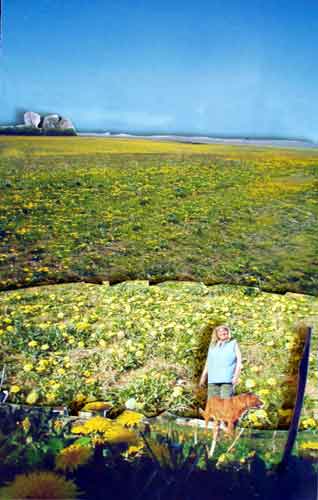
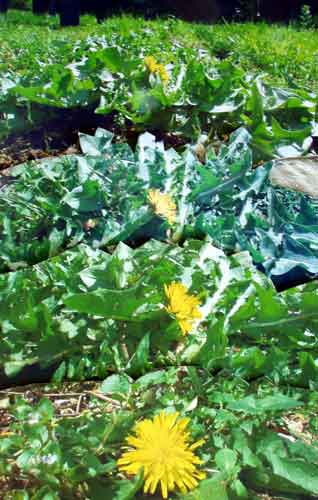
There are lessons to be learned from Taraxacum officinale, the dandelion.A dandelion meadow (left) is a common sight in Eastern Europe. Each flower stalk measures 15-20 cm tall. But in mown grassland the flowers seem to learn to protect themselves (right). Instead of standing tall and erect, they produce inflorescences with shorter stems. What’s more, each stem seems to keep low to the ground, away from the mower’s blades. We know that flowers can follow the sun, undergo sleep movements and make rapid touch responses. These are due to very large changes in K+ and Cl- movements into and out of specialised motor cells. This alters the pressure in the cell, and causes the plant to change its posture. Calcineurin is one of the substances involved in these changes.But how are stimuli passed to the relevant plant structures? What is the role of calcium regulators like calmodulin and frequenin, which has four Ca2+ binding regions? Do they explain the mechanism? The first problem to address is the most basic of all: can Taraxacum truly learn? Does the plant really change its behaviour? A series of experiments is envisaged, where the responses to stimuli could be objectively measured. We still have much to learn about plant response, and perhaps there are lessons to be learned by Taraxacum too. |
 |
|
PLANTS CAN CHANGE THEIR BEHAVIOUR IN THE LIGHT OF EXPERIENCE
. . . OR DO THEY?
|
||
|


